How wallets work
Your funding wallet pays, your dev wallet creates the token, and your buyer wallets buy it.
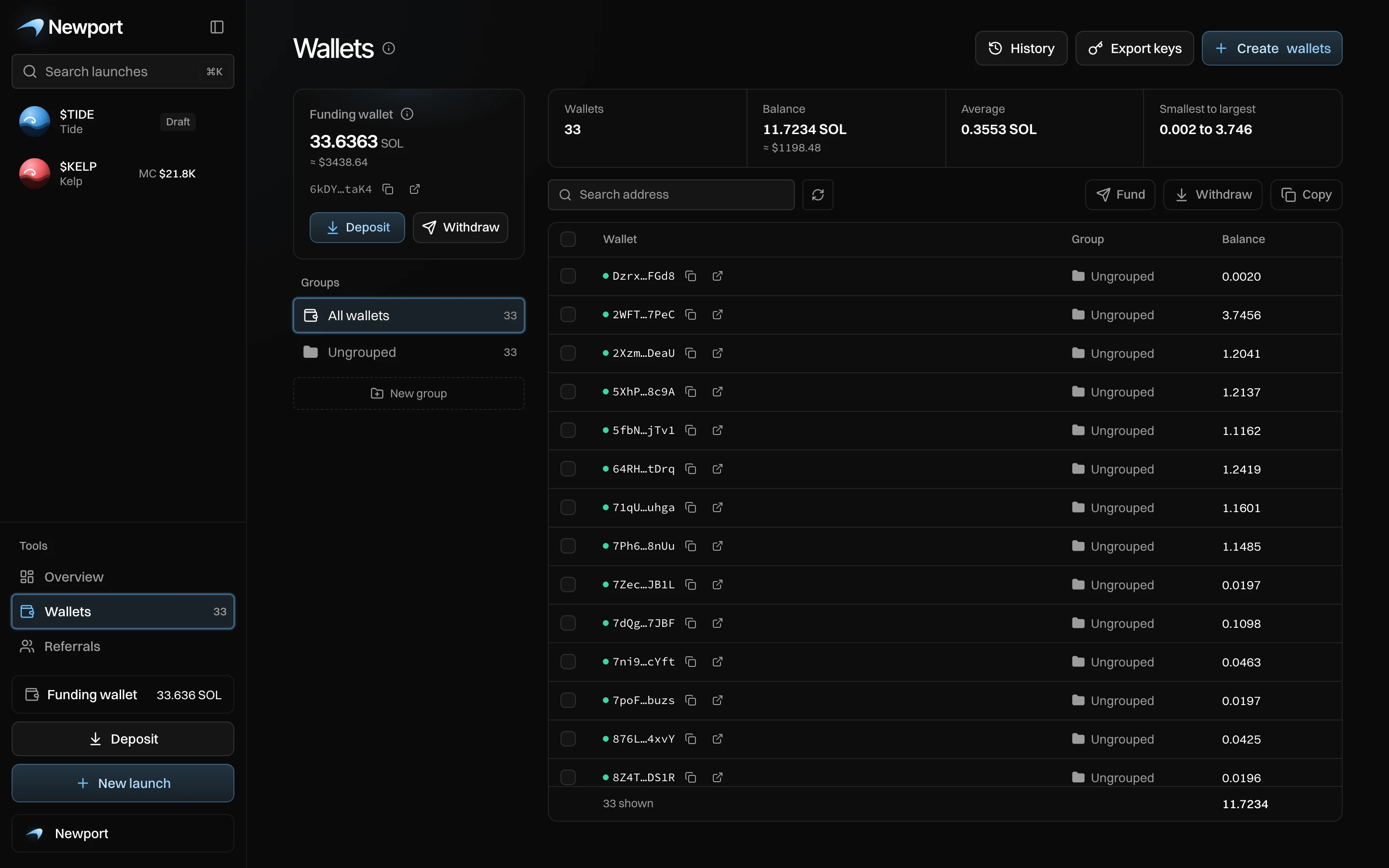
A launch uses many wallets, and each has one job. Your funding wallet holds your SOL and pays. A dev wallet creates the token. Buyer wallets make the buys. Every wallet is yours: Newport keeps its key encrypted, never deletes it, and you can export it any time.
The three kinds
| Wallet | What it does | How many |
|---|---|---|
| Funding wallet | Holds your SOL. Sends SOL to your dev wallet and buyer wallets. It never creates or buys a token. | One per account. |
| Dev wallet | Creates the token, and makes the dev buy in the same transaction. | One per launch. A new one keeps your launches apart. |
| Buyer wallets | Make the buys at launch: Block-0, more bundles, holder buys, and Cleanup's relay wallets, temp holders and holders. | One per buy. |
Your funding wallet is never a dev wallet or a buyer wallet. That keeps the wallet with your money away from the token.
How SOL moves
- You deposit SOL into your funding wallet.
- When you plan a launch, Newport funds its dev wallet and buyer wallets from it.
- The wallets buy at launch, and later sell from the live page.
- Withdraw all to funding wallet on the live page sends what is left back to your funding wallet.
- You withdraw from your funding wallet when you like.
Each wallet keeps a little SOL (0.002 SOL by default) so it can pay the network fee when it sells. See Advanced settings.
Wallet groups
Buyer wallets can sit in named, coloured groups, for example one set per launch. Wallets without a group can be used by any launch. See Create wallets and groups.
Good to know
- You never need to create wallets by hand. Launch settings creates the ones a launch needs, for free.
- Wallets are never deleted, so you never lose access to one. An account can have up to 1,000 wallets.
- Creating a wallet costs nothing. Funding it is a normal transfer with a tiny network fee.